Nats Lose to Cards Again Washington Post
| Washington Senators | |
|---|---|
 Washington Senators club logo | |
| Information | |
| League | American League |
| Ballpark | Griffith Stadium (1911–1960) |
| Yr established | 1901 |
| Year folded | 1960 (relocated to Minnesota and became the Minnesota Twins) |
| Nickname(southward) | Grifs (1912–1920) Nats (1905–1955) |
| American League pennant |
|
| World Series championships |
|
| Former name(s) | Washington Nationals (1905–1955) |
| Old ballparks | American League Park (1901–1903) Boundary Field (1904–1910) |
| Colors | Bluish, red, white |
| Ownership | Clark Griffith (1920–1955) Calvin Griffith (1955–1960) |
| Manager | Clark Griffith (1912–1921) Bucky Harris (1924–1928, 1935–1942, 1950–1954) Walter Johnson (1929–1932) Joe Cronin (1933–1934) |
The Washington Senators baseball team was one of the American League's eight lease franchises. At present known as the Minnesota Twins, the club was founded in Washington, D.C. in 1901 as the Washington Senators.
The team was officially named the "Senators" during 1901–1904, the Nationals during 1905–1955 and the Senators once more during 1956–1960, but nonetheless was commonly referred to as the Senators throughout its history (and unofficially equally the "Grifs" during Clark Griffith'southward tenure as manager during 1912–1920).[one] [two] The name "Nationals" appeared on the uniforms for but two seasons, and then was replaced with the "Due west" logo. However, the names "Senators," "Nationals" and shorter "Nats" were used interchangeably by fans and media throughout the squad'due south history; in 2005, the latter 2 names were revived for the electric current National League franchise that had previously played in Montreal.
For a time, from 1911 to 1933, the Senators were one of the more successful franchises in Major League Baseball. The team's rosters included Baseball Hall of Fame members Goose Goslin, Sam Rice, Joe Cronin, Bucky Harris, Heinie Manush and 1 of the greatest players and pitchers of all time, Walter Johnson. But the Senators are remembered more for their many years of mediocrity and futility, including six final-place finishes in the 1940s and 1950s. Joe Judge, Cecil Travis, Buddy Myer, Roy Sievers and Eddie Yost were other notable Senators players whose careers were spent in obscurity due to the team'south lack of success.[3] [iv]
History [edit]
A losing start for a charter franchise [edit]
When the American League declared itself a major league in 1901, the new league moved the previous small-scale league circuit Western League's Kansas City Blues franchise to Washington, a city that had been abandoned by the older National League a yr earlier. The new Washington lodge, like the quondam i, was called the "Senators" (the second of iii franchises to hold the name). Jim Manning moved with the Kansas City club to manage the offset Senators squad.
The Senators began their history as a consistently losing squad, at times so inept that San Francisco Chronicle columnist Charley Dryden famously joked, "Washington: First in war, first in peace, and terminal in the American League,"[5] a play on the famous line in Henry Lee 3's eulogy for President George Washington equally "First in state of war, first in peace, and first in the hearts of his countrymen". The 1904 Senators lost 113 games, and the next season the team'due south owners, trying for a fresh commencement, inverse the squad's name to the "Nationals" (and occasionally nicknamed the "Nats"). However, the "Senators" name remained widely used by fans and journalists — in fact, the 2 names were used interchangeably[6] — although "Nats" remained the squad's nickname.[7] The Senators name was officially restored in 1956.[eight]
A new era [edit]
The club continued to lose, despite the addition of a talented 19-year-quondam pitcher named Walter Johnson in 1907. Raised in rural Kansas, Johnson was a tall, lanky man with long arms who, using a leisurely windup and unusual sidearm delivery, threw the ball faster than anyone had always seen. Johnson'southward breakout year was 1910, when he struck out 313 batters, posted an earned-run average of 1.36 and won 25 games for a losing ball club. Over his 21-year Hall of Fame career, Johnson, nicknamed the "Big Train", won 417 games and struck out iii,508 batters, a major-league tape that stood for more than 50 years.
In 1911, the Senators' wooden ballpark burned to the ground, and they replaced information technology with a mod concrete-and-steel construction on the same location. First called National Park, it after was renamed Griffith Stadium, after the man who was named Washington manager in 1912 and whose name became almost synonymous with the ball guild: Clark Griffith. A star pitcher with the National League'southward Chicago Colts in the 1890s, Griffith jumped to the AL in 1901 and became a successful manager with the Chicago White Sox and New York Highlanders. Walter Johnson blossomed in 1911 with 25 victories, although the Senators still finished the season in 7th place.[9] In 1912, the Senators improved dramatically, every bit their pitching staff led the league in team earned run average and in strikeouts. Johnson won 33 games while teammate Bob Groom added some other 24 wins to assist the Senators finish the flavor in second place backside the Boston Red Sox.[10] The Senators continued to perform respectably in 1913 with Johnson posting a career-high 35 victories, as the squad over again finished in second place, this time to the Philadelphia Athletics.[eleven] Starting in 1916, the Senators settled back into mediocrity. Griffith, frustrated with the owners' penny-pinching, bought a controlling interest in the team in 1920 and stepped down as field manager a twelvemonth later to focus on his duties as team president.
1924: World champions [edit]

Washington'southward Bucky Harris scores on his habitation run in the fourth inning of Game 7 of the 1924 Globe Series.
In 1924, Griffith named 27-year-old second baseman Bucky Harris player-director. Led past the striking of Goose Goslin and Sam Rice, and a solid pitching staff headlined by the 36-year-former Johnson, the Senators captured their first American League pennant, two games ahead of Babe Ruth and the New York Yankees.
The Senators faced John McGraw's heavily favored New York Giants in the 1924 World Series.[12] Despite Johnson losing both of his starts, the Senators kept footstep to tie the Series at iii games apiece and force Game vii. The Senators trailed the Giants three–1 in the eighth inning of Game seven, when Bucky Harris hit a routine ground ball to tertiary which striking a pebble and took a bad hop over Giants third baseman Freddie Lindstrom. Two runners scored on the play, tying the score at iii.[13] In the ninth inning with the game tied, 3–3, Harris brought in an aging Johnson to pitch on just one day of residuum – he had been the losing pitcher in Game 5. Johnson held the Giants scoreless into extra innings. In the bottom of the 12th inning, Dirty Ruel hit a high foul ball nearly home plate.[xiv] The Giants' catcher, Hank Gowdy, dropped his protective face mask to field the brawl only, failing to toss the mask bated, stumbled over information technology and dropped the ball, thus giving Ruel another chance to bat.[14] On the next pitch, Ruel hit a double and, then proceeded to score the winning run when Earl McNeely hit a ground ball that took another bad hop over Lindstrom's head.[13] [14] Information technology was the only Earth Series triumph for the franchise during their 60-twelvemonth tenure in Washington.
Building a winning tradition [edit]

On behalf of the Elks of Washington, Joe Judge (forepart left), captain of the Senators, was presented with a floral tribute for the team before the start of a game in 1929
The Senators repeated as American League champions in 1925 only lost the World Serial to the Pittsburgh Pirates. After Johnson's retirement in 1927, the Senators endured a few losing seasons until returning to contention in 1930, this time with Johnson every bit manager. Only later on the Senators finished third in 1931 and 1932, behind powerful Philadelphia and New York, Griffith fired Johnson, a victim of loftier expectations.[xv]
For his new manager in 1933, Griffith returned to the formula that worked for him in 1924, and 26-year-old shortstop Joe Cronin became player-manager. The alter worked, every bit Washington posted a 99–53 record and swept to the pennant 7 games ahead of the Yankees. But the Senators lost the Earth Series to the Giants in five games, and after that, the metropolis would not host some other World Serial until 2019, when the Washington Nationals, its electric current National League squad, defeated the Houston Astros.
Fading fortunes [edit]
The Senators sank all the way to seventh in 1934. Attendance plunged as well, and after the season Griffith traded Cronin to the Ruby-red Sox for journeyman shortstop Lyn Lary and $225,000 in cash (even though Cronin was married to Griffith's niece, Mildred). Despite the return of Harris every bit manager in 1935–42 and 1950–54, Washington remained mostly a losing brawl club for the next 25 years, contending for the pennant only in the talent-thin war years of 1943 and 1945.
In the autumn of 1953, the 2d major baseball franchise shift of the mid-20th century took place (afterwards the Boston Braves moved to Milwaukee in 1952), with long suffering Baltimore civic and business organisation interests purchasing the perennially cellar-habitation St. Louis Browns from controversial just enterprising owner Neb Veeck and moving them forty miles (64 km) northeast of Washington to the Chesapeake Bay port city. In the spring of 1954, the Browns moved to a newly renovated and modernized Memorial Stadium on the site of their former northeastern city collegiate football game bowl, and replacing the earlier minor league level "Triple A" "Orioles" (too sometimes nicknamed the "Birds") of the International League where they had been consistent champions since the 1910s. The boosted competition in the same League for Maryland and Virginia surface area baseball fans added to the complexion around the nation'southward capital for the rest of the 1950s as the new "Baltimore Orioles" swiftly built their team prospects with astute trades and farm system output during the rest of the decade, finally condign pennant contenders by 1960. They continued their winning ways every bit ane of the well-nigh dominant teams in professional baseball for the next 2 decades overpowering even the hapless third Senators franchise in 1961–1971.
The Senators were also the butt of many nationwide jokes during the 1950s, with the debut and running of a Broadway musical play in 1955 in New York City called "Damn Yankees" (based on an earlier best-selling novel and later movie in 1958), which followed a hapless elderly D.C. fan being given a "Faustian" or "devil's deal," selling his soul to transform the team by becoming a young powerful new Senators thespian (played in the moving picture version by center-throb leading-man actor Tab Hunter) and lead the lowly team to a pennant versus the Yankees.
In 1954, Senators scout Ossie Bluege, with help from longtime third base coach Alan Rupprecht, signed a 17-yr-old Harmon Killebrew. Because of his $30,000 signing bonus, an enormous corporeality for that time, baseball rules required Killebrew to spend the residuum of 1954 with the Senators as a "bonus baby." Killebrew bounced betwixt the Senators and the pocket-sized leagues for the next few years. He became the Senators' regular third baseman in 1959, leading the League with 42 dwelling house runs and earning a starting spot on the American League All-Star squad.
Relocation [edit]
Clark Griffith died in 1955, and his nephew and adopted son Calvin took over the team presidency. He sold Griffith Stadium to the city of Washington and leased it dorsum, leading to speculation that the team was planning to movement, as the Braves, Browns and Athletics had done in the early 1950s, and the Giants and Dodgers would practise later in the decade. Later an early amour with San Francisco (with a "Triple A" Pacific Coast League team, the San Francisco Seals), by 1957 Griffith was courting Minneapolis–St. Paul in the Upper Midwest country of Minnesota, a prolonged process that resulted in his rejecting the Twin Cities' first offering[16] before agreeing to relocate. The American League opposed the motility at first, but in 1960, in the face of the Continental League'south proposed Minnesota franchise, a deal was reached. The Senators moved and were replaced with an expansion Senators squad for 1961. The erstwhile Washington Senators became the new Minnesota Twins; the expansion Senators would become the Texas Rangers in 1972, and baseball would not return to the city until 2005, when the erstwhile Montreal Expos became the Washington Nationals.
Photos [edit]
-
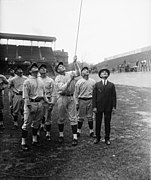
The Washington Senators led past star Walter Johnson and owner Clark Griffith hoist their championship banner at the 1925 opening day.
-
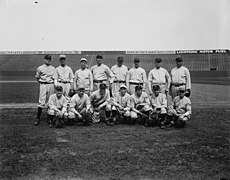
Washington Senators in the 1920s
-

Washington Senators Team Picture in the early 1930s
The Washington Senators in pop culture [edit]
The longtime competitive struggles of the team were fictionalized in the 1954 book The Year the Yankees Lost the Pennant, which became the 1955 Broadway musical Damn Yankees and the 1958 film starring and so "heart-throb" leading-human being actor Tab Hunter). The plot centers on Joe Boyd, a center-aged real estate salesman and long-suffering fan of the Washington Senators baseball club. In this musical one-act-drama of the Faust legend, Boyd sells his soul to the Devil and becomes slugger Joe Hardy, the "long ball hitter the Senators need that he'd sell his soul for" (every bit spoken past him in a throwaway line almost the kickoff of the drama). His hitting prowess enables the Senators to win the American League pennant over the then-dominant Yankees. One of the songs from the musical, "You Gotta Accept Centre", is frequently played at baseball games.
The (expansion) Washington Senators were mentioned several times in Tom Clancy's volume Without Remorse. As they performed fifty-fifty worse than the team they replaced, they were the subject of an updated joke: "Washington: Starting time in state of war, offset in peace, and withal last in the American League." When the current Nationals had their own struggles, the joke was updated once over again, this time to "Washington: Kickoff in war, first in peace, and terminal in the National League."
See also [edit]
- Listing of Minnesota Twins seasons
References [edit]
- ^ Fleming, Frank. "Sports Encyclopedia". Retrieved 8 September 2020.
- ^ "Minnesota Twins Team History & Encyclopedia". Baseball-Reference.com. Retrieved 2008-09-24 .
- ^ Grosshandler, Stan (February 1981). 13 Most Forgotten Stars In Major League History. Baseball Assimilate . Retrieved iii May 2012.
- ^ Vass, George (August 1999). 20th Century All-Overlooked Stars. Baseball game Digest . Retrieved 3 May 2012.
- ^ Dryden, Charles (June 27, 1904). "untitled". Washington Post.
- ^ Kelly, John (six October 2012). "Picking the National's team name all past blueprint". The Washington Post.
- ^ "Tigers Climb Into Second Place - Defeat Nats Twice, A's Upset Tribe". Leningrad Times. Associated Printing. 1940-06-16. p. 19. Retrieved September 6, 2012.
- ^ "Washington Senators (Nationals) (1901-1960)". world wide web.sportsecyclopedia.com.
- ^ "1911 Washington Senators". Baseball-Reference.com. Retrieved xxx April 2012.
- ^ "1912 Washington Senators". Baseball-Reference.com. Retrieved 30 April 2012.
- ^ "1913 American League Squad Statistics and Standings". Baseball-Reference.com. Retrieved 30 April 2012.
- ^ "1924 Globe Serial". Baseball-Reference.com. Retrieved 29 April 2012.
- ^ a b "1924 World Serial Game seven box score". Baseball-Reference.com. Retrieved 29 April 2012.
- ^ a b c Ruel, Muddy (Oct 1964). How Senators' Strategy Won for Johnson. Baseball Digest . Retrieved 29 April 2012.
- ^ Thomas, Henry West.: "Walter Johnson: Baseball's Big Train", page 319. Bison Books, 1998
- ^ "Senators Reject Bids to Move to Minneapolis or St. Paul". New York Times. Associated Press. October 27, 1957. Retrieved 2008-05-02 .
Source: https://en.wikipedia.org/wiki/Washington_Senators_%281901%E2%80%931960%29

Postar um comentário for "Nats Lose to Cards Again Washington Post"