How Corporate Families Passan Their Wealth to Children?
An immediate family is the i members of which are related by blood or share a bond through spousal relationship, adoption, cohabitation, or civil partnership. They can be first-degree relatives, such as parents, siblings, spouse, children, or relatives by lineage like in-laws, grandparents, cousins, adopted and stride-children, or ceremonious and cohabiting partners.
The definition of immediate or close relatives varies with the police force, blazon of arrangement, and nature of the investment. Based on this, an individual may be bailiwick to many advantages and disadvantages. For instance, companies decide compensation or leaves in the event of sickness or decease of such members. Likewise, legal and financial documents grant or prohibit certain rights and financial transactions.
- Immediate family pregnant refers to first-degree or close relations formed through birth, blood, marriage, adoption, civil partnership, or cohabitation.
- Understanding the terms of the Family and Medical Leave Act (FMLA), updating financial paperwork, and preparing a volition are necessary to protect close relatives and safeguard their interests.
- Consideration of immediate family members under dissimilar laws and corporate policies determines whether they will exist entitled to social and financial benefits.
- Individuals with first-degree relatives become privileges depending on the state of affairs, such every bit taking care of a sick family member, attending the funeral of someone close, or participating in the stock market place.
Who Is Considered In Immediate Family?
The offset-degree or close relative appears to exist a common term, and many individuals believe they are familiar with information technology. Nonetheless, considering of its scope, it is hard to discern what is immediate family. The clauses in legal and financial documents and company policies may contain data about it that differs from what most people retrieve to be true.
In full general, it is a family defined by blood, including parents, siblings, and children. When continued through marriage and lineage, the concept extends to spouses, in-laws, adopted and stride-children, grandparents, and grandchildren. Moreover, ceremonious partners and cohabiting individuals also fall into first-degree relatives. It may fifty-fifty include uncles, aunts, and great-grandfathers.
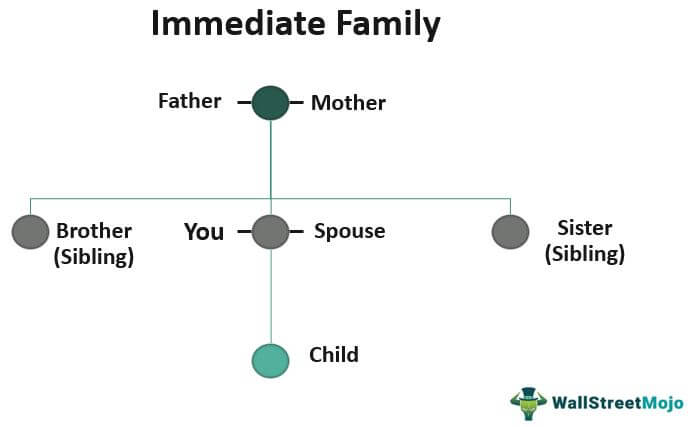
You are free to apply this image on your website, templates etc, Delight provide us with an attribution link Article Link to be Hyperlinked
For eg:
Source: Immediate Family (wallstreetmojo.com)
Understanding which definition is applicable in a particular situation makes information technology easier for individuals to empathize how they would benefit. From deciding whether an employee will exist allowed paid or unpaid vacation to their stock market place Stock Market works on the basic principle of matching supply and need through an auction procedure where investors are willing to pay a certain corporeality for an asset, and they are willing to sell off something they have at a specific toll. read more participation, close relatives play a critical role in many fiscal decisions. Besides, many countries have specific laws defining which member would be considered a close relative for immigration purposes. In some cases, these laws limit the visitation of shut relatives to permanent residents or restrict cross-border travel.
For example, the government of Canada has recently announced the limited exemption on its border brake measures in the wake of the COVID-nineteen pandemic. Equally a result, immediate or close family unit members of permanent Canadian residents, including spouses, dependent children, parents, common-constabulary partners, or guardians, volition exist able to reunite after borders were shut downwards in March 2020.
How Immediate Family unit Influences Financial Matters?

You are complimentary to use this prototype on your website, templates etc, Please provide us with an attribution link Article Link to be Hyperlinked
For eg:
Source: Immediate Family (wallstreetmojo.com)
#one – Official Leaves
Whether an employee will go paid or unpaid leaves for taking care of a close ane depends on how their visitor policy defines close relatives. Also, it is subject to laws of a jurisdiction. For example, the Family and Medical Leave Act (FMLA) permits employees to take a pregnant number of leaves to take physical and psychological care of their first-degree relatives. Aside from parents, siblings, spouse, and children, these relatives may include in loco parentis.
On the other paw, the human resource departments of some companies may define the term differently. Information technology helps them decide whether an employee is eligible for paid or unpaid leaves to take care of the concerned family member.
#two – Will and Inheritance
The immediate family definition plays a crucial function in property distribution afterward the death of a relative. Even if the will specifies a non-starting time-degree relative as the executor of the finances, the first-degree relatives volition withal take access to financial deposits made by the deceased.
In the Us, a few states enforce no-contest provisions just go along the shut relatives from the restrictions. In some states, close relatives are immune a family allowance or homestead allowance.
#3 – Securities/Stock Investment
Dominion 5130 of the Financial Industry Regulatory Authority (FINRA) imposes limits on brokers and dealers when purchasing shares for their close relatives. For example, they cannot sell new bug like initial public offerings (IPOs) to whatever person information technology restricts from availing certain financial benefits. The restricted shut relatives could be relatives past blood and lineage and others who are materially supporting or supported by brokers and dealers.
How To Protect Immediate Family?
On an individual level, the concept of close relatives is greatly personal. About people call back of their parents, siblings, spouse, and children as first-caste relatives. Some people have grandparents, uncles, aunts, and other relatives, who are considerably closer to close relatives. In that location are many ways to protect them both legally and financially.

You are free to use this image on your website, templates etc, Delight provide us with an attribution link Article Link to exist Hyperlinked
For eg:
Source: Firsthand Family (wallstreetmojo.com)
Know the FMLA Provisions
Given the health conditions of the family members, employees need to go through the FMLA provisions. An employee must read their company policies thoroughly and know how they define close relatives. Employees can speak with management if they believe a member who requires special attention due to medical reasons is not addressed in the policy. In most cases, the clauses are negotiable if the person-in-concern has no 1 else to wait after.
Continue Financial Documents Updated
It is essential to keep all the financial documents upwardly-to-date, including banking concern deposits, belongings papers, and other investments having the clause of beneficiaries. Also, checking how a particular financial institution Financial institutions refer to those organizations which provide business organisation services and products related to financial or monetary transactions to their clients. Some of these are banks, NBFCs, investment companies, brokerage firms, insurance companies and trust corporations. read more or investment musical instrument defines the concept will ensure the smooth transfer of assets.
Prepare A Will
While preparing a will, ane must mention the rights to avails each family fellow member would get. This mode, they can safeguard the interests of every member before their soul rests in peace. A will also protects the family members financially, especially those who genuinely need resources. Again, inheritance laws vary with jurisdictions, and knowing them is of import.
Immediate Family vs Extended Family unit
People often discover it confusing to differentiate between an immediate and an extended family. In simpler words, the former is the smallest family unit with all members related by blood. And the latter extends beyond starting time-caste relatives, and its members take lineage connections.
An immediate or close family includes parents, siblings, spouses, and children. When children become married, their spouses and children go firsthand members, and the queue goes on. To understand this concept, let u.s. have a primal character, John, equally an example.
- John is married to Mary, and they both have three children George, Maria, and Sam.
- When children abound up, George gets married to Lisa, and Maria gets married to Peter.
- George and Lisa take 2 children Sarah and Joe, while Lisa and Maria take a son Robert. Sam is still unmarried.
In the above example, John's shut relatives are Mary, George, Maria, and Sam. On the other hand, for his grandchildren Sarah, Joe, and Robert, their uncles, aunts, and their families fall nether extended family. Unmarried Sam is yet the immediate ane for John and Mary. That is how it works.
Frequently Asked Questions (FAQs)
Who is considered immediate family?
Immediate or close relatives are related past blood, including parents, siblings, spouses, and children. However, in some cases, members continued through nascence (grandparents), spousal relationship (in-laws and step-children), adoption, and civil partners and cohabitants are also considered close relatives.
What is a not-immediate family?
Not-immediate family members include grandparents, grandchildren, great-grandparents, slap-up-grandchildren, cousins, uncles, aunts, nieces, nephews, parents-in-police force, siblings-in-law, pace-children, adopted children, half-siblings, civil and cohabiting partners.
What is the deviation between an immediate and extended family unit?
An firsthand family starts with parents, their children, and children'due south families. When these children connect with the families of their spouses or siblings, it converts into an extended family. Similarly, relations directly connected with the children's parents, such as their parents (grandparents), siblings (uncles and aunts), cousins, will be considered part of an extended family.
Recommended Articles
This has been a guide to Immediate family and its meaning. Hither we discuss who is considered and how immediate family influences financial matters along with how to protect them. Yous may observe more about financing from the following articles –
- Family unit Office
- Revenue enhancement Interruption
- Federal Income Taxation
Source: https://www.wallstreetmojo.com/immediate-family/

Postar um comentário for "How Corporate Families Passan Their Wealth to Children?"